Blog
The Wheel of the Year — Eight Sacred Celebrations in the Avalon Tradition

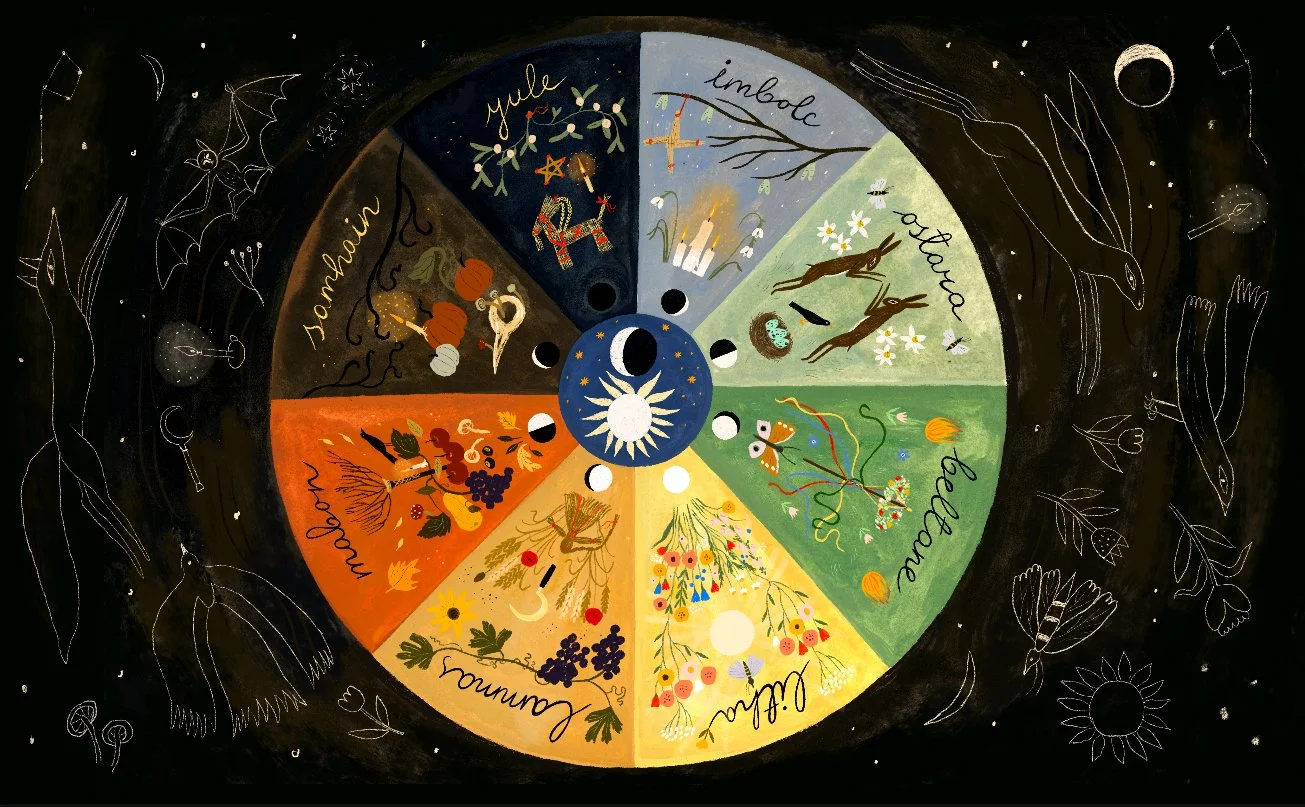
Table of Contents
Time, in the Avalon tradition, does not move in a straight line. It turns. Season into season, darkness into light, descent into return — an endless cycle that mirrors the rhythms of the Earth, of the body, of the inner life. The Wheel of the Year is the ceremonial map of this turning: eight sacred celebrations, evenly spaced through the calendar, each marking a distinct threshold in the solar and agricultural cycle.
For those walking the path of Goddess spirituality, the Wheel of the Year offers something that linear time rarely provides — a framework for living in genuine attunement with the natural world, and a structure for the kind of inner work that each season distinctly invites. Living by the Wheel changes the experience of a year: what was once a sequence of months to be managed becomes something closer to a living conversation with the Earth itself.
What Is the Wheel of the Year?
The Wheel of the Year is a cycle of eight seasonal celebrations observed across many contemporary pagan and earth-based spiritual traditions, with roots in the pre-Christian cultures of Europe — particularly the Celtic and Norse worlds. The eight festivals divide the year into four major thresholds and four cross-quarter celebrations.
The solstices and equinoxes — Yule (winter solstice), Ostara (spring equinox), Litha (summer solstice), and Mabon (autumn equinox) — mark the astronomical turning points of the solar year, the moments when the relationship between light and dark formally shifts. The cross-quarter festivals — Imbolc, Beltane, Lughnasadh, and Samhain — fall midway between them, and carry some of the oldest and most powerful mythological weight in the European spiritual calendar. Samhain and Beltane in particular reach back into the very oldest layers of Celtic culture, pre-dating the Roman occupation of Britain.
Together, the eight celebrations form a complete cycle: a year lived with intention, in conscious rhythm with the Earth and its turning.
The Wheel of Avalon — Eight Faces of the Goddess
What distinguishes the Wheel of the Year in the Avalon tradition is the layer of Goddess mythology woven through each celebration. Each of the eight festivals is presided over by a specific archetypal face of the Goddess — drawn from the mythological heritage of the British Isles, the Celtic world, and the broader Avalonian tradition as transmitted through the Glastonbury Goddess Temple.
These are not abstract symbols to be contemplated at a distance. They are living energies, encountered through ceremony, through the landscape, through the inner work each season uniquely calls for. The Goddess meets you differently at each threshold — and over years of practice, each meeting deepens.
Yule — Winter Solstice welcomes the Cailleach, the ancient one, keeper of the deep cold and the long dark. The longest night of the year holds a particular quality of stillness — and within that stillness, the seed of returning light. Yule asks us to trust the darkness, to rest within it, and to receive what can only come in silence. Yule is governed by the element of Air, inviting us to dream our visions for the season to come.
Imbolc — celebrated at the beginning of February — honours Brigid, Goddess of the sacred flame, of poetry, of healing and craftsmanship. The first breath of spring is barely perceptible beneath the winter ground, but it is there. Imbolc is the festival of what is beginning to stir: in the Earth, and in ourselves. It is one of the most tender of the eight celebrations, and one of the most quietly powerful.
Ostara — Spring Equinox brings balance, and the element of Fire with the returning Sun: equal light and dark, and the clear emergence of new life. Seeds sown at Imbolc begin to show themselves. Ostara and its archetypical Goddess Artha invites action — gentle, intentional, well-timed — and the particular joy of watching something new take its first steps into the world.
Beltane — at the beginning of May — is the great festival of life at its most abundant: of desire, of creative force, of the sacred union between the Goddess and the land. Love, flowering, and the full generosity of the living world, expressed through Goddess Rhiannon. Beltane asks nothing of us but full presence — to the beauty of what is alive, and to the life moving through us.
Litha — Summer Solstice holds the peak: the longest day, the fullest light. In the Avalon tradition, Litha calls both the radiant Goddess and Domnu — ancient Goddess of the deep waters — a reminder that beneath every height, the depths are present. Joy and grief, radiance and longing, live side by side here. Litha invites us to honour our emotions, without clinging to what cannot stay.
Lughnasadh — at the beginning of August — is the first harvest, the festival of the grain, presided over by Ker, the Great Mother Goddess of earth and abundance. What has been grown through the year is now gathered and honoured — a moment to receive fully before the slow release of autumn begins. Gratitude here is not a sentiment but a practice: the conscious recognition that the Earth has given, and that the giving deserves to be met with presence.
Mabon — Autumn Equinox brings the second balance point of the year: equal light and dark, and a deepening movement inward. Mabon is held by Banbha — Goddess of the sovereign earth, of groundedness and of roots — calling us back into the body, back into the land, back into what is solid beneath our feet. The element of Earth dominates here: this is a time for honest reckoning, for completing what can be completed, for releasing what has served its purpose, and for finding the stability that makes descent possible.
Samhain — perhaps the most sacred of all eight celebrations, at the beginning of November — marks the end and the beginning of the Celtic year and pagan calendar. The veil between the worlds of the living and the dead is thinnest. The ancestors are honoured and welcomed. The Crone speaks,and so does Goddess Cerridwen of the great Cauldron of transformation. What must die, dies — and in dying, makes way for what will be reborn in the seasons to come. Samhain is the festival that asks the most of us, and gives the most in return.
Celebrating the Wheel of the Year — In Milan and Online
At the Milan International Goddess Temple, each of the eight celebrations is marked with a dedicated celebration, in person and online — in collaboration with Libreria Esoterica Milano, one of Milan’s most respected spiritual and esoteric spaces, and open to all who wish to attend.
These are genuine cerimonial gatherings, led by a Priestess of Avalon: not theatrical performances or spiritual tourism, but living ritual in the tradition of the Glastonbury Goddess Temple. Each celebration follows the mythological and ceremonial structure of the Avalon tradition, adapted to the Milanese landscape and to the community that gathers around the Temple. Whether you are new to the Wheel or have been celebrating it for years, these gatherings offer a grounded, lineaged container for seasonal practice.
For those who cannot attend in person, celebrations are also offered online. Anna also serves as ceremonial Priestess for the Glastonbury Goddess Temple‘s official online Wheel of the Year celebrations held in English — details available through the Temple’s offerings page and newsletter.
The Wheel of the Year and the Phases of the Moon
Many practitioners of Goddess spirituality work with both the Wheel of the Year and the lunar cycle simultaneously — and the two rhythms complement each other in ways that become increasingly apparent over time.
The Wheel maps the solar year: the great arc of light and dark governed by the relationship between the Earth and the Sun. The Moon, by contrast, moves in a much shorter cycle of approximately twenty-eight days, offering a more frequent and intimate rhythm of reflection and renewal. New Moon, waxing, full, waning, dark — each phase carrying its own quality of invitation, its own particular kind of work.
At the Milan International Goddess Temple, both cycles are honoured. The eight celebrations of the Wheel are held as communal ceremonies; the monthly Full Moon women’s circle offers a more regular, more intimate gathering space. Together, they create a complete framework for a spiritually grounded year — one in which there is always a threshold approaching, always an invitation to pay attention.
The Wheel of the Year as Inner Journey
Beyond the external calendar, the Wheel of the Year functions as a map of the inner life. Each season calls a specific quality of attention: the long introspection of winter, the tender beginnings of early spring, the outward creative energy of summer, the honest reckoning of autumn. Samhain asks what must be released. Imbolc asks what is beginning to stir. Beltane asks where the joy is. Mabon asks what has been enough.
Engaging with the Wheel over years — particularly within a genuine spiritual tradition, with ceremony and community — changes the relationship with time itself. The year ceases to be a sequence of months to be managed and becomes something more like a living entity, with its own wisdom, its own rhythm, its own demands and gifts.
This is one of the oldest and most grounded offerings of Goddess spirituality: the possibility of living in genuine attunement with the world, rather than in spite of it.
Frequently Asked Questions:
I have no experience with Goddess spirituality. Will I feel out of place?
No. The celebrations are designed to be welcoming to anyone arriving with genuine curiosity and an open attitude. Many people attend their first seasonal celebration knowing very little about the tradition and find it immediately accessible. You do not need to believe anything in particular — only to be present.
What actually happens at a seasonal celebration?
Each celebration follows a ceremonial structure rooted in the Avalon tradition: the opening of sacred space, the invocation of the season’s Goddess, guided meditation or inner journey, shared ritual, oracle card reading, and the closing of the circle. Celebrations last approximately ninety minutes to two hours. You will leave with something to carry — not just information, but experience, and often a gift.
Are online celebrations as meaningful as in-person ones?
Yes, in my experience. The ceremonial container holds regardless of physical location. Many people who attend online do so from across Europe, North America, South America, and Asia, and report the same quality of encounter as those present in the room.
See you at the Temple,
Anna
Priestess of the Goddess and of Avalon
I am a Priestess of the Goddess and of Avalon, and the Founder of the Milan International Goddess Temple. I trained at the Glastonbury Goddess Temple in the United Kingdom, where I serve as a celebrant Priestess and Melissa of the Temple. I hold a PhD in Old Norse, and for years I have woven historical research and spiritual practice into the work I carry at the Temple — in Milan and online. If the Wheel of the Year and the Avalon tradition are calling you, my seasonal celebrations and sacred offerings are open to all.

