Blog
Celtic Handfasting — The Ancient Ceremony of Union


Table of Contents
You may have come across the word in a film, in a friend’s account of a ceremony, or somewhere in the vast and often bewildering landscape of wedding inspiration. Handfasting. Something about it stayed with you — a quality of depth, of rootedness, of something older and more serious than the average ceremony script. You are wondering what it actually is.
This is an honest answer: the history, meaning, and symbolism of the Celtic handfasting ceremony as it is understood and performed within the living tradition of Avalon. Written by a Priestess of Avalon who has officiated these ceremonies in Italy and has been trained at the Glastonbury Goddess Temple — and who understands why, for a growing number of couples, nothing else quite fits.
What Is Handfasting?
Handfasting is one of the oldest recorded ceremonies of union in the Celtic and northern European world. At its heart is a simple and extraordinarily powerful gesture: the hands of two people are joined together and bound with a cord or ribbon, as a visible, physical symbol of the commitment they are making to one another.
From this gesture comes one of the most widely used phrases in the English language: tying the knot. Most people who use this expression have no idea that it refers to a specific ritual act — the literal binding of hands in a ceremony of union that predates the church wedding, the civil registry, and every other institutional form of marking a partnership that exists in the Western world.
The cord that binds the hands is not merely decorative. In the ceremony, it carries the weight of the intention spoken over it — the vows, the witnesses, the sacred space, the elemental forces invoked. When the hands are unbound at the end of the ceremony, the couple carries the cord with them as a physical record of what was spoken and sealed. Many couples keep it on an altar, frame it, or tie it around a meaningful object. The gesture persists beyond the moment.
The Origins — A Pre-Christian Celtic Tradition
The roots of handfasting reach back into pre-Christian Celtic culture — a world in which the marking of significant thresholds was understood as a sacred act requiring ceremony, witnesses, and the invocation of forces larger than the individuals concerned.
The earliest written references to handfasting in the British and Irish traditions describe it as a form of formal union — publicly declared, witnessed by the community, and understood as binding in a way that the spoken word alone was not. The physical joining and binding of hands gave the commitment a reality that language by itself could not achieve. In a culture that understood the spoken word as carrying genuine power, the gesture of binding added a dimension that made the union visible, tangible, and witnessed by both human and other-than-human presences.
In some historical contexts, handfasting was practiced as a form of provisional union — a commitment made for a year and a day, at the end of which the couple could choose to formalize the partnership permanently or to part without social penalty. This practice reflects a sophistication about the nature of human relationships that many contemporary couples find strikingly modern: the understanding that commitment, to be genuine, must be freely renewed rather than simply assumed.
The tradition was largely suppressed across the British Isles and Ireland following the imposition of ecclesiastical marriage law in the medieval period, which required Christian ceremony as the sole legitimate form of union. It survived in folk practice, in remote communities, and in the cultural memory preserved through mythology and oral tradition. Its contemporary revival — through the Goddess spirituality movement, Celtic neopaganism, and the Avalon tradition specifically — has restored it as a living ceremony available to couples seeking something rooted, meaningful, and genuinely their own.
Tying the Knot — The Symbolism of the Cord
The cord used in a Celtic handfasting ceremony is one of its most visually striking elements — and one of the most symbolically rich. Its colour or colours, its material, and the way it is chosen or made all carry meaning. Many couples choose cords in colours that hold personal significance; others work with the celebrant to select colours aligned with the elements, the season, or the specific intention of the ceremony.
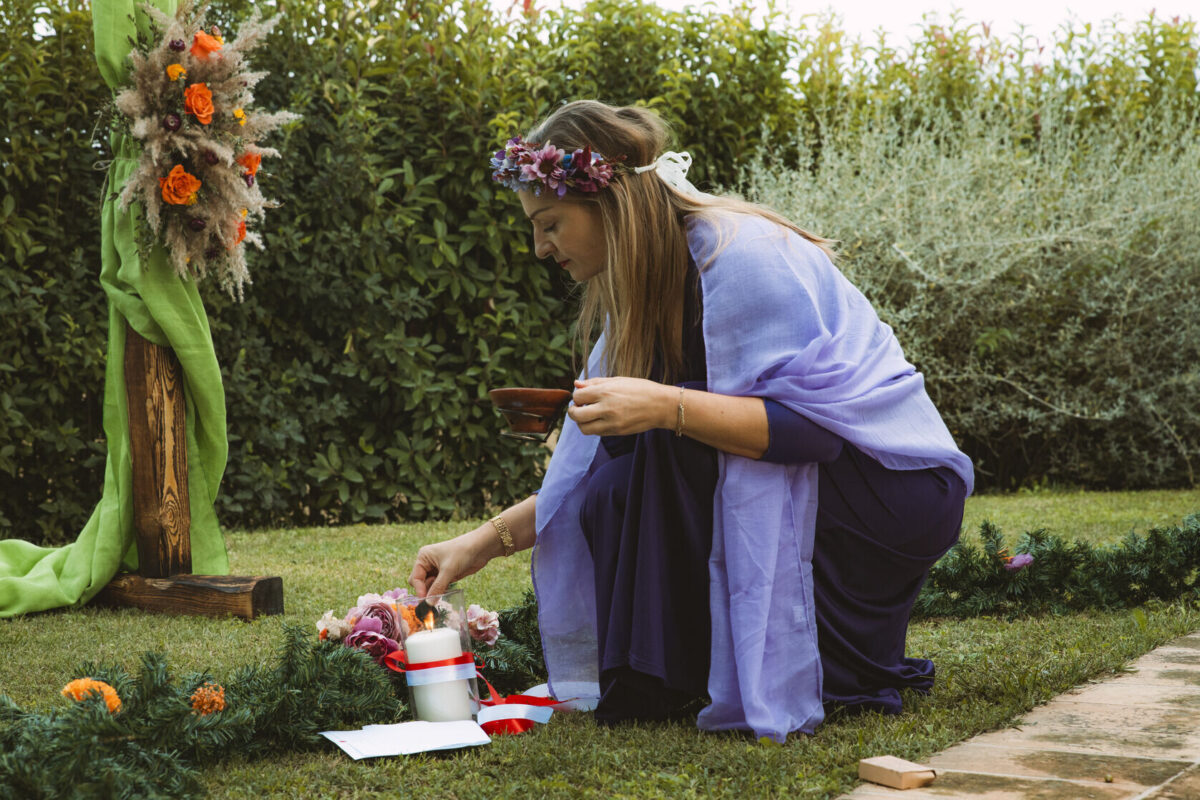
In the Avalon tradition, the elements are always present in a handfasting ceremony — Earth, Water, Fire, Air, and Spirit — each invoked to witness and support the union. The cord may incorporate these correspondences, or they may be present through other ceremonial elements: candles, water, flowers, incense, a chalice. The ceremony is built around the specific couple, their intentions, and the sacred container they wish to create around their union.
The binding of hands — the moment of the handfasting itself — takes place within this container. The Priestess of Avalon, or celebrant, places the cord over the joined hands of the couple and guides the binding as the vows are spoken. The knot is not tied in the sense of a simple loop; it is formed by the movement of the ceremony itself, by the words and the presence of all who witness it. When the hands are unbound, the knot remains — sealed by what was said and meant within it.
What Happens in a Handfasting Ceremony
A Celtic handfasting ceremony, as performed within the Avalon tradition, is a structured ritual with a coherent inner logic — not a collection of borrowed elements assembled for aesthetic effect, but a genuine sacred ceremony with roots in a specific lineage of practice.
The opening of the ceremony establishes the sacred space: the four directions and their associated elements are called, the ancestors may be honoured, and the presence of the Goddess is invoked to witness and bless the union. This is the moment of transition from ordinary to sacred time — a threshold that the couple and their witnesses cross together.
The heart of the ceremony is the exchange of vows and the handfasting itself. The vows in this tradition are spoken freely and from the heart — they are not prescribed texts but genuine declarations, shaped in conversation with the celebrant in the weeks before the ceremony. They may address the qualities the couple wishes to cultivate together, the challenges they commit to facing with honesty, the way they wish to hold one another through the changes that time will bring. When the vows are complete, the hands are joined and bound.
The closing of the ceremony releases the sacred space — the directions and elements are thanked and dismissed, the witnesses are acknowledged, and the couple emerges from the ritual container as a formally and spiritually united partnership.
Every handfasting I officiate is designed entirely around the couple: their story, their values, their vision for what the ceremony should hold. No two ceremonies are identical, because no two couples are.
Symbolic or Legal — Understanding Your Options
One of the most practical questions couples ask about handfasting is whether it can serve as a legally recognised marriage ceremony. The answer depends on the country and the legal framework in which the ceremony takes place.
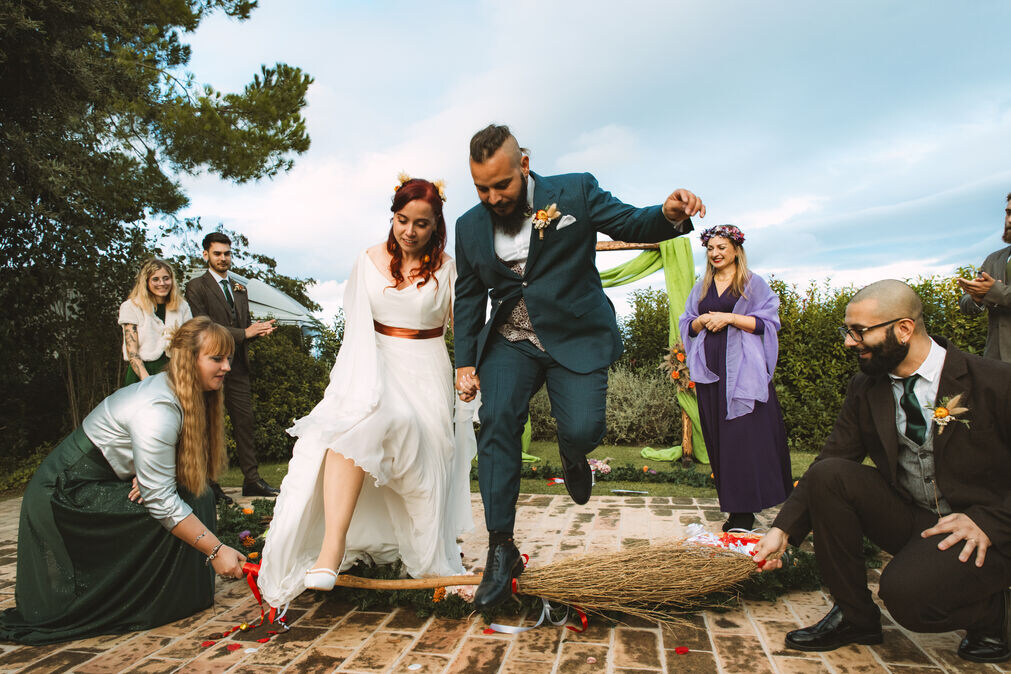
In some jurisdictions — including Scotland and Ireland — a handfasting conducted by a registered celebrant can carry full legal validity as a marriage ceremony. In others, including Italy, the civil and the spiritual dimensions of a union are kept legally separate: a handfasting serves as a deeply meaningful spiritual ceremony, while civil registration takes place separately — before or after — through the appropriate legal channels.
Many couples find that this separation is not a limitation but an opportunity: the civil registration becomes a practical formality, and the handfasting becomes the ceremony that actually matters — the one they have designed, the one they will remember, the one that holds what they actually wanted to say to each other.
Why Couples Choose Handfasting Today
Couples who choose a Celtic handfasting ceremony today come from many different backgrounds and hold many different relationships to religion, spirituality, and tradition. What they tend to share is a sense that the standard options — the church wedding, the civil registry, the generic humanist ceremony — do not fully hold what they want to express.
A handfasting offers something different: a ceremony that is genuinely theirs, rooted in a real and ancient tradition, held by a Priestess of Avalon who brings genuine practice and presence rather than a script. A ceremony in which the words spoken have been written by the couple themselves, in which the elements and the sacred are invoked not as decoration but as genuine witnesses, and in which the moment of union carries the weight it deserves.
For couples considering a handfasting in Italy — one of the most beautiful ceremonial settings available in Europe — the following blog post offers a complete practical guide to planning the experience.
Ready to plan yours? Read the complete Guide to Handfasting in Italy here.
See you at the Temple,
Anna
Priestess of the Goddess and of Avalon
I am a Priestess of the Goddess and Priestess of Avalon, and the Founder of the Milan International Goddess Temple. I trained at the Glastonbury Goddess Temple in the United Kingdom, where I serve as a celebrant Priestess and Melissa of the Temple. I hold a PhD in Old Norse, and I officiate Celtic handfasting ceremonies in Italy and internationally, within the living lineage of the Avalon tradition. If you are considering a handfasting or symbolic wedding, my sacred ceremonies and offerings are the place to begin.

