

Blog
Glastonbury Sacred Sites — A Pilgrimage through the Eyes of a Priestess of Avalon


Table of Contents
I have lost count of how many times I have landed at Bristol and taken the bus south. I recognise the moment of arrival before I even see the Tor against the Somerset sky — something in the air changes. A quality of attention, of aliveness. Glastonbury Avalon is a place you do not arrive at for the first time. You return to it.
I have travelled widely. I know how to distinguish a beautiful place from a living one. Glastonbury is both — but above all, it is this: somewhere that something real and subtle moves, consistently, unmistakably, for anyone with the presence of mind to notice it. I have been returning here for years as a Priestess of Avalon ordained at the Glastonbury Goddess Temple, where I serve as a celebrant Priestess and Melissa — a specific role within the Temple dedicated to holding sacred space and accompanying those who come seeking genuine encounter with the Goddess and the tradition of Avalon.
This is not a tourist guide. It is what I see every time I come here — the Glastonbury sacred sites through the eyes of someone who works within the tradition that calls this place home. If you are planning a pilgrimage to Glastonbury Avalon and want a guide who knows these places from the inside, I am available during my regular residencies at the Temple.
Glastonbury Avalon — A Threshold in the Heart of England
Before describing the individual sacred sites, something needs to be said about what Glastonbury Avalon is as a whole — because reducing it to a list of attractions would be a fundamental misunderstanding of what this place is.
Many spiritual traditions regard Glastonbury as the heart chakra of the planet: the point at which the Earth’s energetic network — the ley lines — concentrates with particular intensity. The St Michael’s Ley Line, one of the principal energetic arteries of western Europe, crosses this territory exactly, connecting Glastonbury to St Michael’s Mount in Cornwall, Mont Saint-Michel in Normandy, the Sacra di San Michele in northern Italy, and continuing east towards Jerusalem.
As the Founder of the Milan International Goddess Temple, I work with both ends of this sacred geography — the Celtic landscape of Glastonbury Avalon and the ancient Goddess sites of northern Italy — and the continuity between them is one of the things that moves me most deeply. Medieval churches dedicated to St Michael were built systematically along this line, following — consciously or not — a quality of the land that cultures across millennia have consistently perceived as sacred.
For the Avalon tradition specifically, Glastonbury is understood as a portal between the worlds — a place where the veil between the visible and the invisible is thin, where time moves differently, where the inner and outer landscapes converge. Until the twelfth century, Glastonbury was literally an island, surrounded by the marshes of the Somerset Levels. The mythological Isle of Avalon — the place of healing, of the deep feminine mysteries, of the Otherworld — was not only metaphor. It had a physical reality that the landscape still carries, legible to those who come with the right quality of attention.
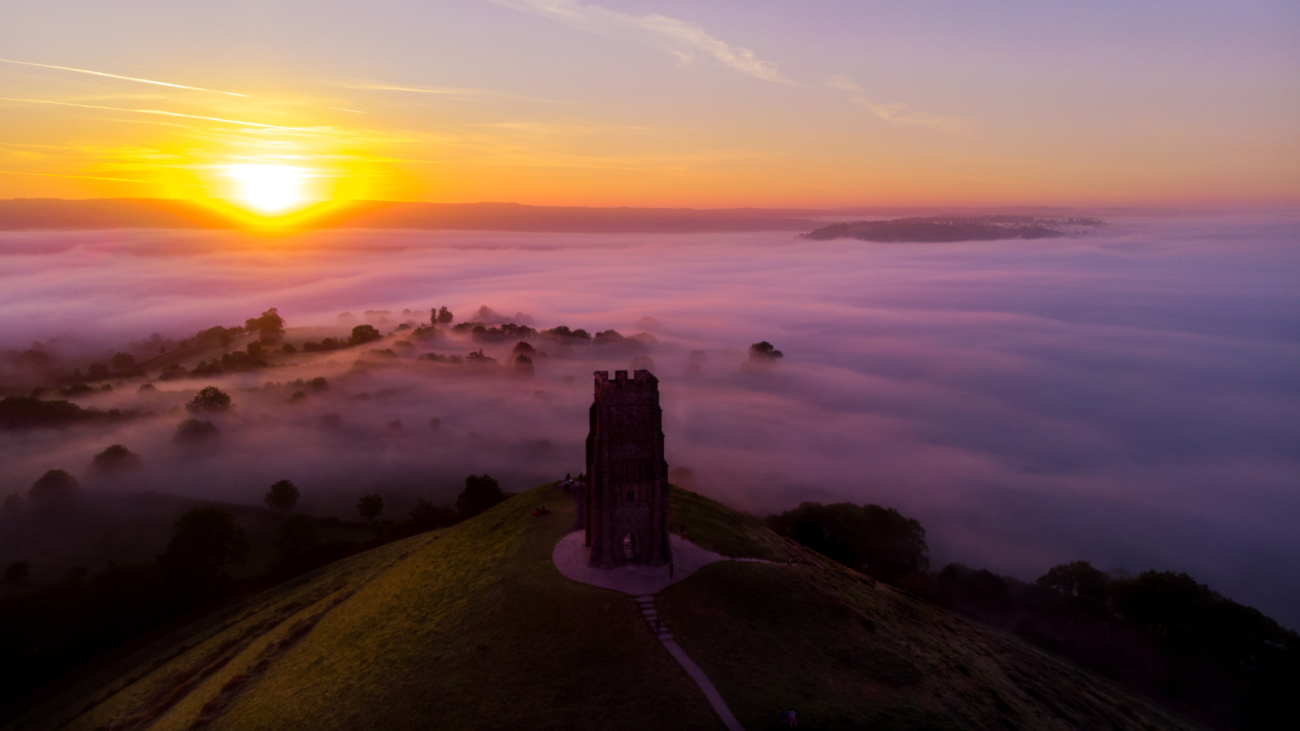
Glastonbury Sacred Sites:
The Glastonbury Tor
The Tor is the first thing visible on approach to Glastonbury Avalon, and the last thing that leaves you when you go. A conical hill rising 160 metres above the Somerset plain, it dominates the landscape with a presence that is not only geographical. At its summit, the tower of St Michael — all that remains of a fourteenth-century church — stands against the sky with a stillness that words reach for and rarely fully find.
Tor is a Celtic word meaning simply “high hill.” What distinguishes this one from any other is the series of terraced ridges that wind around it — seven levels, which researchers have interpreted as an ancient ritual labyrinth, a processional path that once led pilgrims or initiates in a spiral ascent to the summit. In the Avalon tradition, climbing the Tor is an act of pilgrimage in itself: each spiral turn corresponding to a deeper level of inner work, of integration, of encounter with the Goddess.
The Tor carries deep connections to Gwyn ap Nudd, the figure from Welsh mythology understood as guardian of the Otherworld — lord of the realm of the dead and the unseen, keeper of the threshold between the living and what lies beyond it. At the base of the Tor emerge two sacred springs — one with iron-rich red waters, one with calcium-white waters — two complementary forces, solar and lunar, arising from the same deep source beneath Glastonbury Avalon. Both belong to the landscape of this hill and to any serious pilgrimage of it.
Chalice Well — The Red Waters of Glastonbury
The Chalice Well Gardens are, for many pilgrims, the most immediately accessible heart of Glastonbury Avalon. Something slows on entering — breath, pace, the internal rhythm that usually drives us forward without pause. The iron-rich spring water has coloured the stones of the garden path a deep red-orange for millennia: the colour of blood, of the life force, of the endlessly renewing cycle.
The tradition associates the Chalice Well with the Grail — the sacred cup of Arthurian legend, and behind it a far older current in which the cup or cauldron is the vessel of the Goddess: the container of the waters of life, the womb of the world. The well cover bears the symbol of the vesica piscis — two overlapping circles, an ancient symbol of the intersection between worlds, of the meeting of the feminine and masculine sacred, of the opening between what is visible and what lies beneath.
Drinking this water is a ritual act. Sitting in silence beside the pool, or immersing your hands in the flow, is one of the most direct ways to feel Glastonbury Avalon in the body rather than merely in the mind. This is a place that works through the senses, not through the intellect.
The White Spring
Directly across the road from the Chalice Well entrance stands a Victorian stone building that gives nothing away from the outside. Inside: darkness, the sound of water moving over candlelit rock, altars to the Goddess and the God, the smell of beeswax and damp stone.
The White Spring is managed by community volunteers as a sacred space open to all. Its waters — white, calcium-rich, iron-free — are the counterpart to the Chalice Well: where those waters are red and solar, these are pale and lunar. Together, the two springs hold the full polarity of the Glastonbury landscape — two streams arising from the same depths, flowing in complementary directions.
The White Spring is not a visitor attraction. You enter in silence. You sit. You listen. Ritual bathing in its waters is part of the spiritual practice of many who come to Glastonbury Avalon. If there is one place where I consistently feel time stop — as a physical sensation, not a poetic description — this is it. Do not miss it.
Glastonbury Abbey
The ruins of Glastonbury Abbey occupy a large and profoundly atmospheric site in the town centre. What stands today — magnificent even in ruin, golden stone against the Somerset sky — represents only a fraction of what was once the wealthiest and most influential monastery in medieval England.
According to tradition, Joseph of Arimathea brought Christianity to Britain through Glastonbury, establishing the first Christian church here centuries before the Roman mission of Augustine. The Glastonbury Thorn — a hawthorn said to flower at Christmas as well as in spring — is associated with this founding legend. Hawthorn, notably, is one of the most sacred trees in the Celtic tradition, appearing also in the founding mythology of ancient Milan: the same tree, the same threshold quality, across two sacred geographies I know intimately.
The Abbey is also the claimed burial site of King Arthur and Guinevere, whose remains were reportedly discovered here in the twelfth century. Whether or not one accepts this claim historically, what matters is that Glastonbury Avalon has been understood for over a thousand years as the earthly resting place of the most significant mythological king of Britain — and of his queen. The Lady Chapel, built on the site of the oldest Saxon church, is dedicated to the Virgin Mary: another moment in the long continuity of feminine sacred presence at the heart of this landscape.
My background in pre-Christian northern European traditions, developed through years of academic research, informs the way I read these ruins — the layers of religious continuity, the deliberate superimposition of Christian sacred space onto much older foundations, the consistent honouring of a feminine divine presence through every shift of culture and belief. Standing in the Abbey with that knowledge actively changes what you see there entirely.
Coming to Glastonbury — How I Can Help
There are many ways to visit Glastonbury. You can move through it efficiently with a map and a guidebook. You can also come differently: accompanied by a Priestess of Avalon who has spent years working within the tradition that holds these places sacred, who knows them not as landmarks but as living presences, and who can hold space for a genuine encounter with the landscape of Avalon.
During my regular residencies at the Glastonbury Goddess Temple, I am available to guide individuals and small groups through the Glastonbury sacred sites — with historical and mythological depth, and the ceremonial attention that makes the difference between visiting and actually arriving. Each pilgrimage is shaped around the person, their intentions, and what they are seeking.
Contact me in advance to find out when I am next in residence and to plan your Glastonbury Avalon experience.
Frequently Asked Questions:
Can I not simply visit these sites on my own?
You can, and many people do. What a guided experience adds is the difference between seeing a place and actually arriving in it. I bring years of relationship with this landscape, the mythological and historical context that makes each site legible, and the ceremonial presence that allows the visit to function as a genuine pilgrimage rather than a scenic walk. Many people who visit Glastonbury alone return and say they wished they had come with a guide the first time.
How far in advance do I need to plan?
Contact me as soon as you have a rough idea of your travel dates. I return to Glastonbury regularly throughout the year, and availability for guided experiences depends on when my residencies fall. The earlier you reach out, the more likely we are to find an overlap. In the meantime, please visit the Pilgrimage to Glastonbury Avalon page for all information.
Is Glastonbury worth visiting if I am not already interested in paganism or the Goddess tradition?
Yes. Glastonbury is one of the most historically and atmospherically extraordinary places in the world — significant in Arthurian mythology, in early Christian history, and in the ancient sacred landscape of Britain. Interest in the Goddess tradition enriches the experience considerably, but it is not a prerequisite for finding the place deeply affecting.
See you at the Temple,
Anna
Priestess of the Goddess and of Avalon
I am a Priestess of the Goddess and of Avalon, and the Founder of the Milan International Goddess Temple. I trained at the Glastonbury Goddess Temple in the United Kingdom, where I serve as a celebrant Priestess and Melissa of the Temple. I hold a PhD in Old Norse, and I return to Glastonbury Avalon throughout the year to celebrate, collaborate, and serve the tradition in which I trained. My private pilgrimages and sacred experiences in Glastonbury and Milan are available for individuals and small groups.
Available for academic consultancy, media interviews, and documentary collaborations on Glastonbury Avalon, the Avalon tradition, and goddess sacred sites in Britain and Italy — contact Anna.

